BAROMETRUL Informat.ro - INSCOP Research - Edition IX, April 2026. Chapter 3: The War in Iran | 56.1% of Romanians believe that the economic effects of the war in Iran will persist for a long time.



Always see our news on Google
BAROMETER Informat.ro - INSCOP Research - Edition IX, April 2026
Chapter 3: The War in Iran
According to BAROMETER Informat.ro – INSCOP Research, edition IX, conducted between April 1-7, 2026, more than half of Romanians believe that the economic effects of the war in Iran, such as rising fuel prices, will persist for a long time.
BAROMETER Informat.ro – INSCOP Research is a monthly opinion poll conducted by INSCOP Research on behalf of the news platform Informat.ro in partnership with the Strategic Thinking Group think tank.
BAROMETER Informat.ro – INSCOP Research aims to bring to the public's attention topics of interest to stimulate national conversations about various subjects and essential public policies for the present and future of Romania, based on the opinions of Romanians in partnership with think tanks and prestigious academic institutions. It is an initiative through which we aim to contribute to the strengthening of democracy by using scientific and credible tools that bring the voice of citizens to the forefront of public debate.
Methodology: Data was collected between April 1-7, 2026. Research method: interview via questionnaire. Data was collected using the CATI method (telephone interviews), with a simple stratified sample volume of 1100 people, representative of significant socio-demographic categories (gender, age, occupation) for the non-institutionalized population of Romania, aged 18 and over. The maximum allowable error of the data is ± 3%, at a confidence level of 95%.
Graphical presentation of the data is available here.
Remus Ștefureac, director INSCOP Research: "The data from the Barometer Informat.ro – INSCOP shows that Romanians combine a diffuse realism indicated by the fact that the majority expect a longer conflict in the Middle East, with persistent economic anxiety. This suggests that the legitimacy of foreign policies will increasingly depend on the internally felt economic costs. Additionally, the data reveals a divide between the urban-educated public, more informed and more skeptical about the effectiveness of Western military interventions, and the more disengaged public, with a high level of uncertainty. The proportion of those who believe in the success of the US-Israel operations is greater than the proportion of skeptics, but the level of confidence is fragile. There is an erosion of strategic optimism, even within clearly pro-Western segments. Meanwhile, geopolitical perceptions begin to align partisanship, which may lead to an excessive alignment of foreign policy in disputes and internal partisan/ideological preferences. This is a phenomenon that risks causing some long-term strategic coherence difficulties, without precedent in Romania in the last 3 decades."
The War in Iran
Duration of the War in Iran
16.6% of survey participants believe that the war in Iran will last a month or less. 11% estimate a duration of 2-3 months, 11.1% - between 3 and 6 months, 9.2% - between 6 and 12 months, while 28.1% believe it will exceed 12 months. 24% do not know or cannot estimate.
People aged between 30 and 44, residents of Bucharest, and employees in the private sector believe in a higher proportion than the rest of the population that the war in Iran will last more than a year. Those who do not know or cannot estimate how long the war in Iran will last include: AUR voters, people over 60, those with primary education, and residents of rural areas.
Economic Effects of the War in Iran
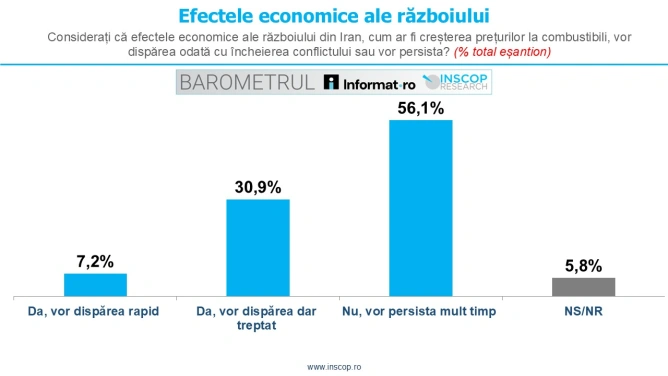
7.2% of Romanians believe that the economic effects of the war in Iran, such as rising fuel prices, will disappear quickly once the conflict ends. 30.9% believe that the effects will disappear, but gradually, while 56.1% think they will persist for a long time. The proportion of non-responses is 5.8%.
Those who believe that the economic effects of the war in Iran will disappear quickly once the conflict ends are in a higher percentage than the average: people aged between 30 and 44, those with primary education. PNL and USR voters, women, young people under 30, people with higher education, residents of Bucharest and large urban areas, and public sector employees believe in a higher proportion than the rest of the population that the economic effects of the war will disappear, but gradually. They believe that the economic effects of the war will persist for a long time in a higher percentage than the average: PSD voters, men, and employees in the private sector.
Success of the Military Operation in Iran
46.7% of respondents believe that the United States and Israel will succeed in the military operation against Iran, while 35.4% hold the opposite opinion. 17.8% do not know or do not respond.
Those who believe that the military operation against Iran will be a success are in a higher percentage than the average: PNL voters, men, young people under 30, and those with primary education. USR voters, people aged between 45 and 59, those with higher education, and residents of Bucharest believe in a higher proportion than the rest of the population that the United States and Israel will not succeed in the military operation against Iran.
Latest News
10:18
10:18
10:14
09:59
09:56
See more news