ANALYSIS The shadow that will cross Europe: the total solar eclipse on August 12, 2026



Always see our news on Google
The Moon will completely cover the Sun on Wednesday, August 12, in a narrow strip that will cross Greenland, Iceland, the Atlantic Ocean, Spain, and a small part of Portugal. For millions of Europeans, the phenomenon will be the first total eclipse visible on the continent since 1999, while Romania will be on the edge of the spectacle, with a partial eclipse observable only in the west of the country.
A rare spectacle for Europe
A total solar eclipse occurs when the Moon passes directly between the Earth and the Sun and covers the disk. Although the shadow of the Moon will cross a limited area, a partial eclipse will be visible from a much larger territory, including regions of North America, the Atlantic, and Europe. Nearly a billion people could observe at least part of the phenomenon, but only about 15 million will be in the path of totality.
The event is all the more significant for continental Europe as the last visible total eclipse in this region occurred in 1999. In Spain, the path of totality will cross the peninsula from the Atlantic coast to the Mediterranean Sea and will also include the Balearic Islands, making the country the main European destination for observers and astronomy enthusiasts.
Where to see totality
The path of the total eclipse will begin in the Arctic region and will pass over Greenland, Iceland, and the Atlantic Ocean before reaching the Iberian Peninsula. NASA indicates that the territories on the path of totality include Greenland, Iceland, northern Russia, Spain, and a small area of Portugal.
Outside this strip, the Moon will only cover part of the solar disk. Italy, France, and other European regions will experience a partial eclipse, with varying percentages of coverage depending on the location. In northern and central Italy, the coverage can be very high, even if the Sun does not completely disappear.
Why Spain is the "favorite"
Northern Spain is considered one of the best observation areas, not only because it is in the path of totality but also due to the position of the Sun in the sky during the phenomenon. Locations such as La Coruña, Oviedo, Santander, Bilbao, Zaragoza, and areas along the Mediterranean coast will be able to witness the passage of the Moon's shadow, with durations of totality varying from place to place.
However, the proximity of the eclipse to sunset introduces a significant risk: the western horizon must be as clear as possible, and clouds or terrain can compromise the observation. For photographers and tourists, the choice of location will depend on a balance between the exact position in the path of totality, weather forecast, and access to an open horizon.
What happens during the minutes of totality
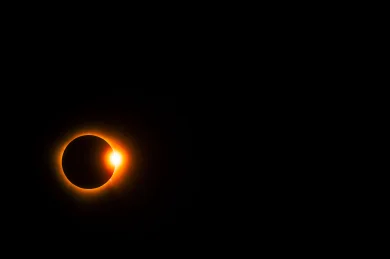
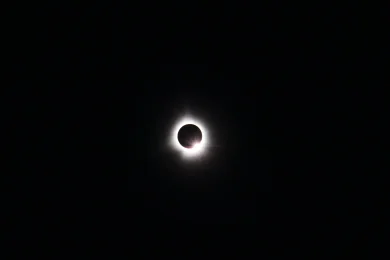
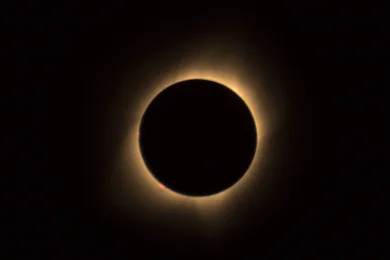
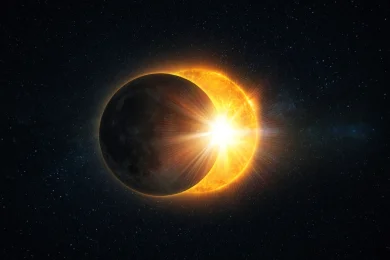
As the Moon covers the Sun, daylight rapidly decreases, the temperature may drop, and the landscape takes on a twilight atmosphere. Around the black disk of the Moon, the solar corona becomes visible — the outer atmosphere, extremely hot and rarefied, which is normally hidden by the brightness of the photosphere.
During totality, solar prominences, bright spots produced by plasma along the Sun's magnetic field, may also become visible. Observers may also notice the appearance of stars and bright planets, as well as sudden changes in the behavior of birds and other animals, which react to the unusual darkness during the day.
The eclipse in 2026 could also provide an unprecedented scientific perspective on the solar corona. Observations and images taken from the ground, from airplanes, and from space can capture structures and dynamics of the Sun's atmosphere that are not visible under normal conditions, including phenomena that are difficult to observe even with space instruments.
Timing of the phenomenon
Globally, the partial eclipse will begin around 15:34 GMT (18:34 Romanian time), and totality will start approximately at 16:58 GMT. The maximum of the eclipse is calculated for around 17:46 GMT, and the last region on the path will exit totality around 18:34 GMT.
The exact times vary significantly from one point to another. In Europe, observers need to check locally both the start of the partial eclipse and the moment of entry into totality, as the Sun will be at different heights above the horizon, and in some areas, the phenomenon will occur close to sunset.
How it looks from Romania
Romania is not in the path of the total eclipse. In the west of the country, however, a partial eclipse will be observable, with the greatest coverage in the northwest, in the Carei area and nearby locations. There, the Moon will cover about 34% of the solar disk, and in some points in the extreme west of the country, the percentage may reach about 38%.
The phenomenon will begin around 20:20–20:24, Romanian time, and will unfold very close to sunset. In the Carei area, the observation could last at most about 26 minutes, which means that an unobstructed western horizon will be essential. From Bucharest and the eastern regions of the country, the eclipse will not be visible.
For those who want to follow the phenomenon from Romania, the best chances will be in locations such as Carei, Satu Mare, Oradea, Arad, or Beba Veche. In these areas, the sunset will occur during the eclipse, providing the possibility of a spectacular image, but also difficult to capture if the sky is covered with clouds.
Safety first
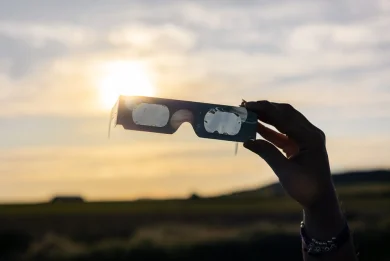
The Sun should not be looked at directly without special protection, not even during a partial eclipse. Regular sunglasses do not block radiation sufficiently to protect the retina; certified eclipse glasses or solar filters designed for astronomical instruments are necessary.
The telescope, binoculars, or camera should not be pointed at the Sun without filters properly mounted on the lens. A safe alternative is projection: the image of the Sun is projected onto a white sheet, allowing more people to observe the shape of the disk and the progress of the eclipse without looking directly at the star.
The only exception is the phase of totality, when the solar disk is completely covered, and observers in the path of totality can look directly for a short time. Once the first bright edge of the Sun reappears, protection must be put back on immediately.
An astronomical and tourist event
The eclipse is also a social event: hotels, trains, observation points, and cities along the path of totality are preparing for a massive influx of visitors.
For those who cannot travel, the phenomenon will also be able to be followed online, through live broadcasts made by astronomical organizations and space institutions. Thus, even from regions where the eclipse is not visible — including Bucharest — the public will be able to watch in real time the entry and exit from totality, the solar corona, and the landscape's reaction to the temporary disappearance of light.
For Europe, August 12, 2026, will not just be an eclipse on the astronomical calendar, but a rare meeting between the precise geometry of the solar system, scientific research, and the public spectacle of a sky darkening in broad daylight.
Latest News
09:23
09:16
09:14
09:02
08:59
See more news
NEWS ON THE SAME TOPICS