IT News Review by Control F5 Software Siemens and Nvidia test a humanoid robot in the factory



Always see our news on Google
Siemens and Nvidia test a humanoid robot in the factory
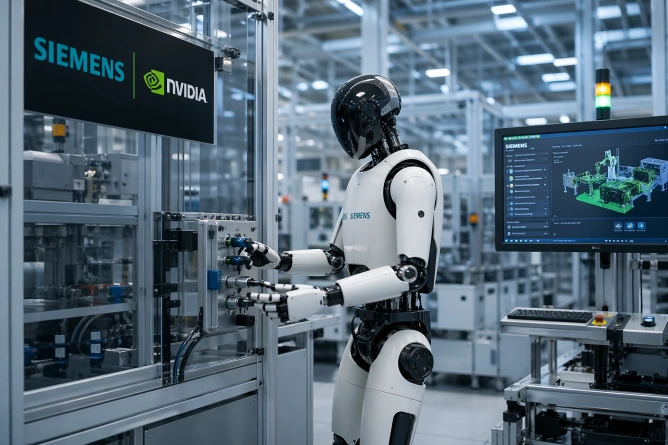
Siemens and Nvidia have tested the humanoid robot HMND 01, developed by Humanoid, in a Siemens factory in Erlangen. The robot performed routine logistics tasks, such as lifting, moving, and placing containers used by employees.
The robot worked autonomously for over eight hours, completed over 90% of tasks, and moved approximately 60 containers per hour. The companies say that using simulation and Nvidia tools has reduced development time from up to two years to about seven months.
For the industry, the test is important as it shows a shift from spectacular demonstrations to concrete operational tasks. Here, the value does not lie in the show, but in the robots' ability to work predictably alongside humans in a real production environment.
Apple's foldable iPhone bets on autonomy
Apple is preparing its first foldable iPhone with a strong focus on battery life, at a time when this criterion has become one of the most sensitive differences between premium foldable models. The implicit comparison arises with rivals like Samsung and Huawei, who already have experience in this category and have set high expectations regarding design and autonomy.
The stakes for Apple are not just the launch of a new hardware format, but also avoiding the classic compromise of foldable phones, namely a device that is spectacular in form but more limited in terms of battery and efficiency. From a software and hardware perspective, the subject shows how important energy optimization has become in a category that combines larger screens, additional weight, and intensive component use.
App Store growth seems fueled by AI
App launches accelerated significantly in the first quarter of 2026. According to Appfigures data, the number of new apps increased by 60% globally, while on iOS, the growth reached 80%. In April, the pace remained high, with a 104% increase across both stores and 89% on iOS.
This wave is linked to new AI tools for programming and prototyping, which make mobile development more accessible for people without deep technical experience. At the same time, the increase in volume puts pressure on Apple's moderation and verification processes, especially after recent cases where problematic or fraudulent apps have reached the top.
For the software industry, the news is relevant as it suggests that AI does not reduce the role of apps but can massively expand the offering. The likely consequence is a more crowded market, where differentiation, quality control, and app security will become even more important.
OpenAI is scaling back side projects
Kevin Weil and Bill Peebles are leaving OpenAI at a time when the company is scaling back initiatives considered secondary and is focusing its resources on AI for businesses and its future "superapp." The departures come after the closure of Sora and the absorption of OpenAI for Science into other internal teams.
OpenAI is simplifying its portfolio and prioritizing projects with direct commercial utility. Sora, for example, was estimated to cost about $1 million per day in computing, and OpenAI for Science was created to accelerate scientific discovery through the Prism platform.
For the AI ecosystem, the move is important as it signals a stage of operational discipline. After a period of visible experimentation, large AI companies seem to be returning to products with clear monetization and direct integration into enterprise workflows.
Anthropic enters rapid design territory
Claude Design has been launched, an experimental product through which users can create prototypes, presentations, one-pagers, and other visual materials directly from prompts. Anthropic says the product is designed especially for founders and product managers without a design background.
The flow is simple: the user describes what they want, Claude generates a first version, and then it can be refined through subsequent requests or direct edits. The direction confirms the expansion of generative models beyond text and code, towards business visual assets used in rapid work stages.
For software and product teams, the news matters as it lowers the entry barrier for internal visual communication. At the same time, it shows that AI assistants are increasingly becoming production interfaces, not just response engines.
Netflix wants a vertical video feed and smarter recommendations
Netflix is preparing a vertical video feed, similar to the one popularized by TikTok, and wants to use AI more extensively for both recommendations and content creation. The company had already tested such a video feed since 2025.
The short feed would help users discover series, movies, and even video podcasts more easily. The article also mentions that Netflix is increasingly relying on AI after introducing a ChatGPT-assisted search.
From a digital product perspective, the stakes are clear: the competition for attention is shifting streaming platforms towards more dynamic and shorter interfaces. The recommendation algorithm becomes even more important, as the discovery experience begins to resemble that of social media.
Luma transforms AI video into a production studio
Luma has launched Innovative Dreams, a creative production company created together with Wonder Project, a studio focused on family films and religious themes. The first project will be "The Old Stories: Moses," featuring Ben Kingsley, released on Prime Video.
The partnership does not present AI merely as an experimental tool but as infrastructure for effective media production. Luma positions the new entity as a combination of experienced filmmakers and AI technology, capable of helping studios realize ambitious ideas.
For the digital content industry, the subject shows that AI video is entering a more mature stage, where value no longer comes just from generation but from integration with real production, distribution, and collaboration flows with established studios.
Europol sends warnings to 75,000 DDoS attack suspects
Europol and other international agencies have sent emails and letters to over 75,000 individuals suspected of using DDoS-for-hire services. These platforms allow launching attacks without advanced technical skills and without their own infrastructure.
The operation is part of PowerOFF, a coordinated effort against services that can take websites offline. Through this approach, authorities aim to discourage both platform operators and clients who pay to launch attacks.
For companies and IT teams, the message is that the demand for on-demand attacks remains active and accessible. At the same time, there is a shift in institutional response tactics, combining technical and legal measures with direct interventions on users of these services.
Google brings web browsing alongside AI Mode
Google is expanding AI Mode in Chrome Desktop so that source pages can be opened alongside the AI conversation, in the same interface. The idea is for the user to be able to consult the page and, in parallel, continue asking questions about the content.
The change shifts the search experience from the classic model, where you exit the response interface and open a new tab, to a more assisted and contextual exploration mode. Essentially, the browser is increasingly becoming a workspace between the page and the conversational assistant.
For software products and search, this type of interface matters as it changes how traffic, source reading, and subsequent questions combine into a single flow. It is an important step in the competition to redefine the browser as an AI-first interface.
Gemini personalizes image generation with context from the Google account
Google adds context-based image generation using Nano Banana in the Personal Intelligence function of Gemini. The system can use context from Gmail, Google Photos, and other connections from the account to produce more personalized images, without all preferences needing to be explicitly mentioned in the prompt.
The examples provided by the company show that Gemini can understand interests, people, or groups from existing labels in Google Photos and can indicate through a source button where the context used comes from. However, Google warns that the system may misinterpret context, and the user can correct or provide feedback.
For the AI market, the news is relevant as the shift from prompt to personal context becomes the new differentiator. From a digital infrastructure perspective, the value lies in deeper integration between the model, personal data, and software surfaces where the user is already working.
Canva transforms the AI assistant into a tool orchestrator
TechCrunch shows that the new version of Canva AI can call multiple tools to produce editable designs starting from text descriptions. The assistant is not limited to generation but plans the task, selects the right tools, and delivers multiple variants.
An important aspect is that designs are built in layers, which keeps them editable and easier to refine. This matters in a professional context, where generated content needs to be quickly integrated into brand flows, campaigns, and working materials.
For marketing, product, and communication teams, Canva is moving in a clear direction: AI becomes a workflow coordinator, not just an asset generator. This reduces execution time and brings design closer to a conversational model, while still maintaining the need for human control at the adjustment and visual consistency level.
DeepL wants to translate voice, not just text
DeepL has launched a voice-to-voice suite for translating conversations in meetings, on the web, on mobile, and in dedicated applications for field workers. The company is also launching an API through which businesses and developers can build their own solutions on top of DeepL technology.
The direction shows a natural expansion of the company from text translation to real-time communication. Mentioned use cases include meetings, call centers, and operational contexts where language barriers slow down work or introduce errors.
For enterprise software, the news matters as it brings voice translation closer to native integration into products and operational flows. We are no longer talking about a standalone tool, but about a service that can directly enter business applications.
LinkedIn says AI does not yet explain the decline in hiring
According to LinkedIn data, the hiring rate has decreased by about 20% since 2022, but the company does not yet see AI as the main cause. The statement was made by Blake Lawit at the Semafor World Economy summit.
The message is important at a time when the market frequently associates the slowdown in recruitment with generative automation. LinkedIn says the observed impact in the data is more likely connected to the macroeconomic context, not to a rapid replacement of jobs by AI.
For business and HR tech, the subject suggests that public perception of AI and the labor market is currently moving faster than aggregated evidence. This does not eliminate the risk of future changes, but it shows that, at present, the data does not yet confirm the scenario of a contraction directly caused by AI.
Google launches native Gemini application for Mac
Google has launched a native Gemini application for Mac, regaining ground against rivals who already had dedicated desktop clients. The application can be quickly opened from any context using the Option + Space shortcut.
Google presents the product as a constantly available assistant, useful for quick checks, formulas, drafting, and other office tasks without changing the active tab. This brings Gemini closer to daily use, in the same space where users have already integrated other desktop AI tools.
For software productivity, the launch confirms that the battle is increasingly taking place at the operating system level and instant access. The interface matters almost as much as the model, as adoption comes from how quickly you can call the assistant in daily work.
Windows 11 prepares improvements for File Explorer
Microsoft is testing an update for File Explorer in Windows 11 that brings faster loading, fixes for white flashes in dark mode, and fewer crashes of explorer.exe. The changes are already present in build 26200.8313 from the Release Preview Channel.
Sel also mentions extended archival support and a scheduled public delivery earlier through the optional update in April 2026, then through Patch Tuesday on May 12, 2026, for the rest of the users. The change comes after Microsoft promised to reduce the focus on integrating Copilot and return to improving core components of Windows.
For enterprise users and IT teams, the news is important as it shows a repositioning towards stability and performance in classic areas of the system. In many organizations, such optimizations have a direct impact on the daily experience, even if they are less spectacular than AI functions.
iPhone 18 Pro tests new colors
Apple is testing at least three colors for the iPhone 18 Pro, including silver, dark gray, dark red, and light blue, with a focus on a shade of red that could become the standout color of the series. The information is attributed to a Macworld report.
Although the subject is one of hardware and aesthetics, it also says something about Apple's commercial strategy. The color palette becomes a tool for differentiation and premium positioning, especially in a category where technical upgrades are increasingly difficult to communicate to the general public.
For the digital product market, such details matter as they influence pre-orders, campaigns, and the perception of novelty. In mature ecosystems, design decisions can have an almost equally significant effect as hardware specifications.
Google Photos and image scanning back in discussion
Google is introducing an update that scans users' photos, alongside the expansion of new AI-based features. There are discussions about the privacy implications of using the photo library for intelligent and personalized functions.
The subject is directly linked to the broader trend where AI models are gaining increasing access to personal data to provide recommendations, content generation, and more contextual responses. In practice, the product's value increases, but so does the sensitivity regarding consent, transparency, and control over data.
For software companies and users, the news confirms that the future of personalized AI will depend not only on capabilities but also on how clearly platforms can explain what data they use and for what purpose.
Microsoft removes Copilot from some Windows applications
Microsoft is removing or reducing Copilot integration from some Windows applications, at a time when the company promises to focus on the core components of the system. The context is also confirmed by the direction described by Windows Latest, which talks about diminishing Copilot integration and returning to improvements for File Explorer and stability.
From a product perspective, this is a sign that AI integration is no longer treated as an absolute priority in every software area. Microsoft seems to be recalibrating where Copilot makes sense and where users value performance, predictability, and a clean interface more.
For the enterprise market, the change shows that AI adoption must be correlated with real utility. Not every integration brings value, and mature products are increasingly being judged by their concrete impact on workflow.
The European Commission allocates 180 million euros for sovereign cloud
The European executive has awarded a contract of 180 million euros for sovereign cloud to four European providers. The objective is to strengthen the digital sovereignty of the Union and reduce dependence on single providers outside the European space.
The message is relevant at a time when the autonomy of digital infrastructure is becoming a strategic, not just technical, subject. The parallel awarding of four contracts suggests a resilience-oriented approach, diversification, and risk reduction.
For software companies and the public sector, this type of investment can influence procurement, compliance criteria, and cloud architectures adopted in future projects in Europe.
The European Commission proposes measures for Google in Search
Brussels has sent preliminary conclusions and proposed measures for Google to comply with the Digital Markets Act in the area of data distribution and search-related functions. The official wording talks about the access of "territories or 'data beneficiaries'" to certain information necessary for their own services.
The news fits into the regulatory offensive against large digital platforms and targets how a dominant player manages access to data, traffic, and the ability of others to build competing products. In practice, the subject affects not only search but also ecosystems that depend on visibility and interoperability.
For the industry, the implication is that the search infrastructure and the rules for distributing information remain a major negotiation field between platforms, developers, and authorities.
AWS launches an AI tool for early drug discovery
Reuters, through search results, reports that AWS has launched Amazon Bio Discovery, an AI tool designed to accelerate early stages of drug discovery. The platform allows researchers to run complex workflows without code and uses specialized foundational models for generating and evaluating candidate molecules.
The system includes an AI assistant for setting parameters and interpreting results, and certain selected molecules can be sent to lab partners for testing. Among the early users are Bayer, Broad Institute, and Voyager Therapeutics, and AWS says that 19 of the top 20 global pharma companies are already using its cloud infrastructure.
For applied software and AI, the news is relevant as it shows how specialized models and no-code interfaces are moving biotechnology towards more operationally accessible platforms. The focus is no longer just on academic research but on the rapid integration of AI into industrial workflows.
Meta could surpass Google in digital advertising revenue
Meta is expected to surpass Google in 2026 in digital advertising revenue, both in the US and internationally.
The subject is important as it signals a major shift in the balance of the ad tech market. If the estimate is confirmed, it means that Meta's model, based on social platforms, short video, and algorithmic attention optimization, gains ground even against the dominant search engine.
For companies investing in digital marketing, the news suggests a repositioning of the relationship between search and social. Budgets, performance measurement, and channel mix will increasingly be influenced by this power shift.
Google explores AI glasses in partnership with Gucci
Google is reportedly preparing a pair of AI smart glasses branded by Gucci, with a launch estimated in 2027, in a partnership reported by Reuters through the Kering group. The device is expected to be inscribed in the Android XR line, following the "Project Aura" model expected in 2026.
For smart glasses, style is almost as important as technology. Google has also announced partnerships with Warby Parker and Gentle Monster, but the association with Gucci takes the product into a much more pronounced fashion and status zone.
For the connected hardware market, the news shows that the success of these devices may depend less on specifications and more on people's real desire to wear them daily. Here, brand and design become essential product elements.
AI Mode from Google brings sources alongside conversation
The expansion of AI Mode in Chrome is confirmed by displaying sources in a parallel panel, without leaving the page. Users can continue asking questions while viewing the source site and can use AI Mode even to search through open tabs.
The update suggests that Google is trying to reduce the gap between conversational responses and traditional web. Instead of replacing the page, AI Mode incorporates it into the experience and transforms it into an active context for subsequent questions.
For the search and publishing ecosystem, this type of interface can change both user behavior and how sources receive attention. The browser simultaneously becomes a summarizer, question engine, and reading surface.
YouTube allows complete shutdown of Shorts
YouTube introduces for all users the option to set the limit for Shorts to zero minutes, which practically eliminates the short clips feed from the app after reaching the limit. The feature was already extended previously in a parental context, and now it reaches regular accounts as well.
After reaching the limit, the Shorts tab no longer displays videos, and this type of content also disappears from Home. From a product perspective, it is a tool for attention control, rare in an environment built precisely for the repetitive consumption of short content.
For digital platforms, the move is interesting as it shows increasing pressure for real time management tools. As short feeds dominate distribution, the demands for options that reduce overexposure also grow.
Adobe brings a conversational AI assistant into editing
Adobe introduces a new Firefly AI assistant capable of using Creative Cloud applications in place of the user. The launch is a fundamental change in creative work, where the user can describe desired changes without mastering the classic editing terminology.
The central message is that the working interface is shifting from menus and tools to natural language. This can reduce the learning time for beginners and accelerate execution for professionals, especially in repetitive tasks or in the early stages of visual projects.
For the creative software industry, the implication is significant: the competitive advantage no longer lies solely in the power of an editor but also in how well it can transform conversation into concrete action on files and projects.
Chrome transforms Gemini prompts into reusable commands
Google is launching a feature in Chrome called Skills, through which Gemini prompts can be saved and reused across multiple selected pages or tabs. The idea is to transform useful commands into repeatable workflows, accessible with a single click.
This approach shifts AI from the realm of occasional interaction to easy automations built by the user. Instead of reformulating the same request every time, the browser begins to remember and execute work patterns.
For productivity and browser-based work, the news is relevant as it shows the convergence between prompt engineering and personal macros. The browser is gradually becoming a no-code automation space.
Google links Gemini to user photos
Google will allow connecting user photos from their account to Gemini and to the generation functions based on Nano Banana. This complements what TechCrunch has already described about Personal Intelligence, namely using context from Google Photos and other services for more personal responses and images.
The subject brings to the forefront the same tension between utility and privacy. The more the model knows about the photo library and personal history, the more it can produce useful results, but also more sensitive in terms of data control.
For consumer AI products, this is one of the clearest signs that competitive advantage will be given by the ecosystem and access to relevant personal data, not just by the quality of the underlying model.
Starbucks tests drink discovery in ChatGPT
Starbucks has launched a beta application in ChatGPT to help users discover new drinks. The system uses personal preferences, dietary restrictions, and seasonal trends to suggest suitable options.
The initiative is relevant as it shifts interaction with the brand from its own app into a conversational space already frequented by users. In this model, AI is no longer just support but becomes a discovery surface for commerce.
For retail and digital products, the experiment shows how chatbots can become channels for recommendation and conversion. If the model works, other brands might also try to bring product experiences directly into the conversational interfaces used daily.
Europe discusses the risk of military dependence on American cloud
A study by the Future of Technology Institute warns about the significant dependence of European defense on American cloud providers. The analysis discusses the risk of a "kill switch," meaning the possibility that access to services or data could be restricted through sanctions, subpoenas, or other legal and commercial mechanisms.
16 European countries are at high risk, including Romania, while another seven are at medium risk due to indirect exposure. The study notes that Microsoft is the largest cloud provider for European defense agencies, and Google and Oracle also appear in relevant contracts.
For European digital infrastructure, the news is very important. It shows that the discussion about cloud sovereignty is no longer just an industrial or economic one, but also a strategic security one.
Zoom partners with World to verify people in meetings
Zoom is collaborating with World, the human identity verification company associated with Sam Altman, to confirm that meeting participants are real people and not AI-generated impostors.
Two relevant examples of deepfake fraud are mentioned, including the Arup case in 2024, where an employee authorized transfers of $25 million after a fake video call, and a similar incident in Singapore in 2025. The context explains why verifying human presence is becoming a function with real value in collaboration software.
For companies, the implication is clear: video conferencing tools are entering a stage where identity security becomes a product component, not just a complementary function. As deepfakes improve, verification will matter more in sensitive financial and operational contexts.
Physical Intelligence says its robot can solve tasks for which it was not explicitly trained
TechCrunch presents research from the startup Physical Intelligence, which claims that its model 𝜋0.7 can guide robots to do things for which they were not explicitly trained. The company describes this as a step towards a "generalist brain" for robots, capable of combining skills and responding to instructions in natural language.
The central example is using an air fryer, where the model combined limited fragments from training data and broader knowledge to understand how the device works. With step-by-step instructions, the robot succeeded in the task, and researchers say that adjusting the prompt raised the success rate from 5% to 95% in an early experiment.
For robotics, the signal is important as it shifts the discussion from memorizing fixed tasks to compositional generalization. Even though the results remain research-oriented and not from a mature product, they indicate a promising direction for flexible automation in real environments.
Hackers use emojis as a signaling and masking layer
TechNewsWorld, citing Flashpoint analysis, writes that actors in cybercrime are increasingly using emojis to signal intentions, categorize activities, and sometimes hide the meaning of messages from external observers. The trend is linked to the shift of conversations from classic forums to Telegram and Discord.
The article explains that emojis function as a rapid, repeatable, and easily scalable language across languages, being useful for indicating access, monetization, hints, or success. As images, they can more easily avoid keyword-based filters and can strengthen the sense of belonging in a restricted community.
For cybersecurity and threat intelligence, the implication is clear: monitoring needs to adapt to more visual, shorter, and contextual forms of communication. Semantic detection becomes as important as traditional textual analysis.
Using AI for basic tasks can reduce cognitive performance
A preprint study tested 1,200 participants on simple fraction problems and text comprehension exercises, with and without AI. The central result is that the group using AI initially solved tasks better but performed worse when assistance was removed.
Participants who used AI made more mistakes or skipped questions when they had to continue on their own and were less persistent in completing exercises. The study also emphasizes the idea of "cognitive debt," a concept separately supported by MIT research on using ChatGPT for essays.
For organizations, education, and AI products, the message is not that tools should be avoided, but that their design matters. If AI constantly takes over the basic cognitive effort, then the user's competence may stagnate or even decrease over time.
Synthesis made with the help of a monitoring flow provided by Control F5 Software.
Latest News
22:56
22:47
22:28
21:57
21:23
See more news
NEWS ON THE SAME TOPICS