Von der Leyen calls for a more independent Europe in energy, defense, and supply chains



Always see our news on Google
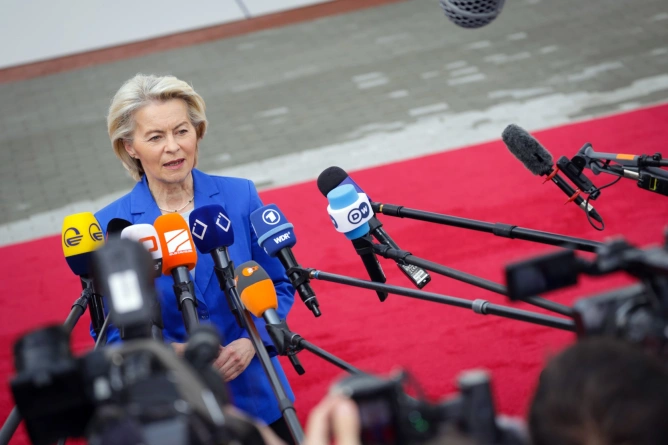
The President of the European Commission stated in Yerevan, before the meeting of the European Political Community, that Europe must reduce its dependencies on imported fossil fuels, accelerate the production of military capabilities, and build more secure supply chains with close partners.
The President of the European Commission, Ursula von der Leyen, stated on Monday in Yerevan that Europe must become more independent in energy, defense, and supply chains, ahead of the eighth meeting of the European Political Community.
In short
Ursula von der Leyen said that the meeting of the European Political Community will mainly discuss the theme of an independent Europe.
The President of the Commission indicated three areas in which Europe must reduce its dependencies: energy, defense and security, and supply chains.
Von der Leyen said that Europe is too dependent on imports of fossil fuels and volatile global markets.
She called for accelerating the production of military capabilities, stating that there are significant amounts available for investments.
The President of the Commission linked the resilience of supply chains to trade agreements and cooperation with politically close countries.
Ursula von der Leyen made the statements in Yerevan, Armenia, ahead of the meeting of the European Political Community. She said that discussions will focus on the theme of an independent Europe and on reducing dependencies in three strategic areas.
"I am very pleased to be here, in Armenia. This is the eighth meeting of the European Political Community. We will mainly discuss the theme of an independent Europe. We need to reduce our excessive dependencies, especially in three areas," said the President of the European Commission.
The first area mentioned by von der Leyen is energy. She stated that Europe remains too dependent on imports of fossil fuels and, therefore, on volatile global markets.
"The first is energy. We are too dependent on imported fossil fuels and, therefore, we are always dependent on volatile global markets. We need to increase our assets at home, in Europe. These are renewable energies and nuclear energy, because they are produced here, they are cheaper and they are reliable," said von der Leyen.
The second area indicated by the President of the Commission is defense and security. She said that Europe needs to increase its military capabilities to be able to defend and protect itself.
"The second area in which we need more independence is defense and security. We need to intensify our military capabilities to be able to defend ourselves and protect ourselves. There is a very large amount of money available for investments. Now we really need to intensify and accelerate the production process for military capabilities," said von der Leyen.
The third element mentioned is the resilience of supply chains. The President of the Commission said that Europe is looking for partnerships with politically close countries and linked this goal to the EU's network of free trade agreements.
"And the third element is represented by reliable supply chains. For this, we address countries with the same vision. We have free trade agreements. We just concluded one with Latin America, but also with India, Australia, and I will go to Mexico. Because alongside friends with the same vision are stable and reliable supply chains. And Europe has the largest network of free trade agreements," she said.
The statement frames three priorities of the current European agenda: energy security, strengthening defense, and diversifying trade partnerships. Von der Leyen presented these themes as elements of a Europe capable of reducing external dependencies and strengthening its own capacity for action.
The European Political Community is a political dialogue format that brings together European leaders beyond the institutional framework of the European Union. The meeting in Yerevan is the eighth meeting of this format.
The statement from Yerevan comes at a time when the European Commission emphasizes reducing strategic dependencies, developing energy produced in Europe, investing in defense, and strengthening supply chains through partnerships with countries considered politically close.
Latest News
16:50
16:32
16:31
16:24
16:13
See more news








.webp)