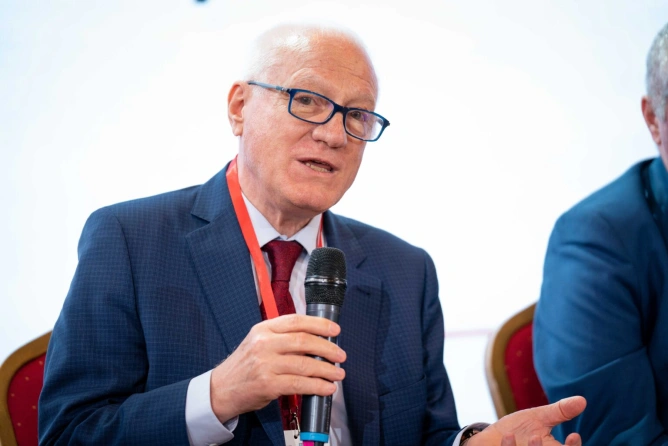
Virgil Popescu believes that Europe should support the construction of housing without creating new agencies or excessive regulations.



Always see our news on Google
The housing crisis is rapidly climbing the European political agenda and begins to outline a clear line of demarcation between the main political families in the European Parliament. While the socialists support the idea of European institutional instruments dedicated to the housing market, the EPP group argues that the problem should be addressed by increasing the supply of housing and by supporting member states, without new administrative structures at the Union level. PNL MEP Virgil Popescu states that the European Union should play a supportive and coordinating role in combating the housing crisis, but warns that solutions should not lead to the creation of new European agencies or excessive regulations. In short Virgil Popescu says that the European Union must support member states in solving the housing crisis, but without excessive regulations. The MEP supports the use of European funds for energy renovation of buildings and for the construction of housing for young people and students. In the European political debate, the EPP rejects the idea of creating a European agency dedicated to housing. The issue of access to affordable housing has been discussed in the context of political meetings in the European Parliament, where the European Commission is preparing a European plan regarding affordable housing. Virgil Popescu believes that the role of the European Union should primarily be one of support for national authorities, including through economic policies that can influence the cost of construction materials and the competitiveness of the European industry. "The European Union must have an integrative and supportive role for national authorities. For example, it will have a significant impact on prices and the future plan for reindustrialization and boosting Europe's competitiveness. What does this mean concretely? For example, materials at affordable prices to stimulate the construction sector, including housing." At the same time, the Romanian MEP supports the expansion of the use of European funds for projects dedicated to housing for young people and students, against the backdrop of increasing difficulties in accessing housing in university cities. "Yes. I support the allocation of funds for the construction of housing for young people and students. And not just in Romania. I must say that I am subjective, but my son studies abroad and it has been difficult to find housing. We need more housing for young people, which they can afford, including with the help of parents who support them during their studies. And colleagues from the EPP support the need for an increase in the allocation of funds for such projects." In the European political debate regarding housing, Popescu also highlights the differences in approach between political families. "The socialists want a housing agency while the EPP says that there is no need for an agency to do what is necessary." According to the Romanian MEP, solutions should focus on increasing the supply of housing and removing administrative obstacles that slow down construction projects. In discussions within the EPP group, several directions of action have been mentioned, including accelerating housing construction by reducing bureaucracy and speeding up the issuance of permits, support for young people and families purchasing their first home, investments in housing for students and social housing, developing public-private partnerships, and training programs for workers in the construction sector to address the labor shortage. Popescu also emphasized the importance of using European funds intended for renovation and energy efficiency of buildings. "I want European funds intended for the wave of renovation and energy efficiency of buildings to be used at a rapid pace, because this will reduce the costs borne by consumers." The MEP added that new housing should be built in accordance with energy efficiency principles. Referring to the situation in Romania, Popescu explained that the housing market operates differently compared to other European states and is characterized by a high preference for ownership. "We in Romania have a different model, to put it that way. Mobility in the labor market continues to remain low, which is why, based on education and society, many of us feel secure if we know we have a roof over our heads, just our own." He mentioned that programs like "First Home" have contributed to increasing access to housing for young people. "Through the First Home program, many young people have managed to get a home. There were also tax incentives offered." At the same time, Popescu acknowledged that access to housing has become more difficult in recent years. "Yes, it is now more difficult and due to the country's financial situation, which has generated a series of imbalances. I hope these will be resolved in the near future." In his opinion, the facilities granted to young people and students for access to housing could become a relevant element in the European debate. "What should be taken from the EU and included in the European debate? The facilities we offer to students and young people to encourage them to make such investments, to feel prepared to also have a family." Access to affordable housing has become an increasingly present issue in the European debate in recent years, especially in large cities where rising prices and rents disproportionately affect young people and young families. In this context, the European Commission is preparing initiatives to improve access to housing, and the debate in the European Parliament reflects differences in approach between political families regarding the role of the European Union in this area.

Latest News
19:09
19:04
18:51
18:50
18:49
See more news









.webp)