The European Commission launches the plan for the eastern border regions, focusing on security, investment, and cohesion
2eu.brussels


EU
Foto: shutterstock.com

Always see our news on Google
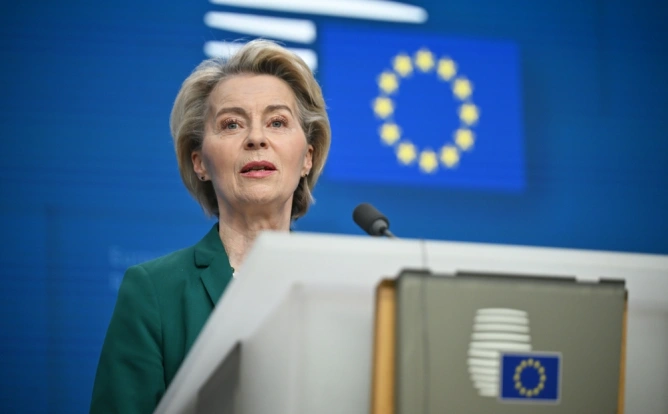
European Commission President Ursula von der Leyen announced in Brussels the launch of the Communication regarding the eastern border regions and a plan of measures in three directions: security and defense, investments, and support for local communities, against the backdrop of Russia's war against Ukraine and the pressures felt directly by the areas at the eastern border of the EU.
In short
The Commission states that it will mobilize up to 800 billion euros by 2030 for defense efforts and indicates the "Defence Readiness Roadmap 2030" as a tool with measurable objectives and deadlines. Almost two-thirds of the 150 billion euros available through SAFE, the EU's common procurement program, are "provisionally allocated" to the eight border states represented at the event. The Commission announces EastInvest, a 20 billion euro financing mechanism designed for border regions, which brings together the EIB, EBRD, private banks, and national financiers, with loans intended for the next two years. The package includes European initiatives such as Eastern Flank Watch and Drone Defence Initiative, a new Drone Action Plan, and "billions" in military mobility investments, plus tripling funding at borders to secure them. The Commission indicates the flexibility of cohesion funds and the use of existing instruments, including for cross-border health services and digital upskilling for local traders.
In her speech, von der Leyen linked the plan to the changing security environment since the beginning of the Russian invasion, stating that "the world has changed overnight," and the strongest impact "has been felt along our eastern borders." She described a combination of economic effects and security risks, from disruptions in transport and tourism to "hybrid threats, instrumentalized migration, and drone incursions."
The security component is anchored in instruments presented as already operational or in the process of implementation at the European level. The Commission President stated that Europe has "made historic steps" towards a Defense Union and that the EU "will mobilize up to 800 billion euros by 2030" for defense efforts, alongside the "Defence Readiness Roadmap 2030." In this logic, she emphasized that the EU has a "laser-like focus" on eastern border security and indicated that "almost two-thirds" of the 150 billion euros available through SAFE are "provisionally allocated" to the eight border states represented at the launch.
The speech also included a set of thematic tools for border risks, such as the pan-European initiatives Eastern Flank Watch and Drone Defence Initiative and a Drone Action Plan that, according to the Commission President, targets threats "from drones to balloons" used for hostile purposes. Von der Leyen also stated that the EU is investing "billions" in military mobility to enable faster deployment of troops and equipment and that it will "triple funding at borders" to secure them.
The economic pillar of the plan is EastInvest, described as a 20 billion euro financing mechanism "specifically designed" for border regions, which brings together public and private sources, including the European Investment Bank and the European Bank for Reconstruction and Development. The Commission President stated that EastInvest will provide loans intended for the next two years and will support projects such as renewable energy, agriculture, and forestry, with the declared goal of creating jobs and economic opportunities in regions affected by the proximity of war.
To illustrate the direction of investments, the speech listed examples from border states. In Poland, the development of a "drone valley" in the southeast was mentioned, in Lithuania the construction of a military base near the border with Belarus, funded by the EIB, which is expected to host "almost 5,000" military and civilian personnel. Examples of projects with industrial components and supply chains were also cited, including a "fiber optic valley" in southeastern Latvia, the production of "critical medicines" in Romania at a research center in Iași, and a magnet factory in the city of Narva in Estonia.
The third pillar is support for communities through existing EU instruments, especially cohesion policy and the common agricultural policy, with the promise that the plan will ensure that "every cent can be spent where it matters." Von der Leyen stated that cohesion funds have been made "much more flexible" and provided as an example a cross-border health service operated by Poland and Lithuania, as well as investments in digital upskilling so that local traders can modernize their tools with cohesion funds.
The speech was delivered in the presence of several leaders of member states at the eastern border and European financial leadership, including Executive Vice President Raffaele Fitto and EIB President Nadia Calviño. Von der Leyen placed the announcement in the continuity of her recent visit to Kyiv, made "at the beginning of this week," to mark the anniversary of four years since Russia's large-scale invasion of Ukraine, and linked the plan for border regions to the need to combine security with regional prosperity.
She also made a reference to the "Helsinki Summit," which she said was agreed upon last year among eight Eastern European states and will strengthen regional security, while indicating that investments in defense and military mobility can generate economic effects in the region through jobs and infrastructure.
In short
The Commission states that it will mobilize up to 800 billion euros by 2030 for defense efforts and indicates the "Defence Readiness Roadmap 2030" as a tool with measurable objectives and deadlines. Almost two-thirds of the 150 billion euros available through SAFE, the EU's common procurement program, are "provisionally allocated" to the eight border states represented at the event. The Commission announces EastInvest, a 20 billion euro financing mechanism designed for border regions, which brings together the EIB, EBRD, private banks, and national financiers, with loans intended for the next two years. The package includes European initiatives such as Eastern Flank Watch and Drone Defence Initiative, a new Drone Action Plan, and "billions" in military mobility investments, plus tripling funding at borders to secure them. The Commission indicates the flexibility of cohesion funds and the use of existing instruments, including for cross-border health services and digital upskilling for local traders.
In her speech, von der Leyen linked the plan to the changing security environment since the beginning of the Russian invasion, stating that "the world has changed overnight," and the strongest impact "has been felt along our eastern borders." She described a combination of economic effects and security risks, from disruptions in transport and tourism to "hybrid threats, instrumentalized migration, and drone incursions."
The security component is anchored in instruments presented as already operational or in the process of implementation at the European level. The Commission President stated that Europe has "made historic steps" towards a Defense Union and that the EU "will mobilize up to 800 billion euros by 2030" for defense efforts, alongside the "Defence Readiness Roadmap 2030." In this logic, she emphasized that the EU has a "laser-like focus" on eastern border security and indicated that "almost two-thirds" of the 150 billion euros available through SAFE are "provisionally allocated" to the eight border states represented at the launch.
The speech also included a set of thematic tools for border risks, such as the pan-European initiatives Eastern Flank Watch and Drone Defence Initiative and a Drone Action Plan that, according to the Commission President, targets threats "from drones to balloons" used for hostile purposes. Von der Leyen also stated that the EU is investing "billions" in military mobility to enable faster deployment of troops and equipment and that it will "triple funding at borders" to secure them.
The economic pillar of the plan is EastInvest, described as a 20 billion euro financing mechanism "specifically designed" for border regions, which brings together public and private sources, including the European Investment Bank and the European Bank for Reconstruction and Development. The Commission President stated that EastInvest will provide loans intended for the next two years and will support projects such as renewable energy, agriculture, and forestry, with the declared goal of creating jobs and economic opportunities in regions affected by the proximity of war.
To illustrate the direction of investments, the speech listed examples from border states. In Poland, the development of a "drone valley" in the southeast was mentioned, in Lithuania the construction of a military base near the border with Belarus, funded by the EIB, which is expected to host "almost 5,000" military and civilian personnel. Examples of projects with industrial components and supply chains were also cited, including a "fiber optic valley" in southeastern Latvia, the production of "critical medicines" in Romania at a research center in Iași, and a magnet factory in the city of Narva in Estonia.
The third pillar is support for communities through existing EU instruments, especially cohesion policy and the common agricultural policy, with the promise that the plan will ensure that "every cent can be spent where it matters." Von der Leyen stated that cohesion funds have been made "much more flexible" and provided as an example a cross-border health service operated by Poland and Lithuania, as well as investments in digital upskilling so that local traders can modernize their tools with cohesion funds.
The speech was delivered in the presence of several leaders of member states at the eastern border and European financial leadership, including Executive Vice President Raffaele Fitto and EIB President Nadia Calviño. Von der Leyen placed the announcement in the continuity of her recent visit to Kyiv, made "at the beginning of this week," to mark the anniversary of four years since Russia's large-scale invasion of Ukraine, and linked the plan for border regions to the need to combine security with regional prosperity.
She also made a reference to the "Helsinki Summit," which she said was agreed upon last year among eight Eastern European states and will strengthen regional security, while indicating that investments in defense and military mobility can generate economic effects in the region through jobs and infrastructure.

Latest News
21:18
Superliga: UTA Arad defeats FC Argeș 1-0 and climbs to 6th place in the standings
21:00
Alexandru Ioan Cuza University of Iaşi suspends the contract of Alexandru Toader, Tudorel Toader’s son, following the decision to place him in pre-trial detention
20:43
France: Jordan Bardella was re-elected to lead the Rassemblement National party with nearly 99%
20:09
ECHR rejects Judge Dorin Munteanu’s application because he concealed the compensation proceedings in Moldova
19:53
The Minister of Health inspected the construction site of the Iași Regional Emergency Hospital / The hospital is expected to be able to receive patients in 2029
See more news

Personalized news feed, AI-powered search, and notifications in a more interactive experience.