The European Commission says that AI applications that undress women and girls are banned on the EU market.



Always see our news on Google
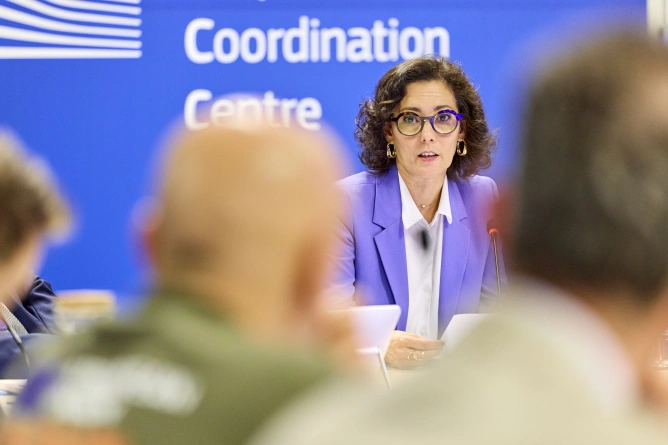
Commissioner Hadja Lahbib said at the OECD Gender Equality Forum that the European Union bans "nudification" applications that generate intimate images of a real person without consent. She linked the measure to online violence against women and girls, in a context where one in five women in the EU has experienced online violence, and among young women, the proportion is one in four.
Artificial intelligence applications that generate intimate images of a real person without consent are banned in the European Union market, said Commissioner Hadja Lahbib at the OECD Gender Equality Forum in Paris. Providers of these systems have until December to comply with European rules.
In short
The European Commission states that AI applications for "nudification" are banned in the EU market.
The ban targets AI systems that generate intimate images of a real person without consent.
In the EU, one in five women has experienced online violence; among young women, the proportion is one in four.
Lahbib stated that 98% of AI-manipulated images are pornographic, and 99% of these depict women.
The Commission is preparing an action plan for women in research, innovation, and startups and aims for one million girls in STEM careers by 2028.
Hadja Lahbib described an increasingly common case: a photo taken from a social media profile is uploaded into an AI application, and within minutes, explicit images are distributed online to peers, family, or strangers. The Commissioner said that such situations are not science fiction but happen to women and girls in Europe and worldwide.
In her speech, Lahbib linked artificial intelligence to online violence, harassment, stalking, hate speech, and image-based abuse. She stated that women activists, journalists, and politicians are targeted because they are visible, and the goal of the attacks is to push them out of the public space.
The European Commission invokes three instruments for the EU's response: the Directive on Violence Against Women, the Digital Services Act, and the AI Act. The Directive directly addresses cyber violence, the Digital Services Act is used to hold platforms accountable, and the AI Act bans manipulative and deceptive forms of artificial intelligence and seeks to combat gender biases in algorithms.
Lahbib said that the EU has gone further by banning "nudification" applications. Any AI system that produces intimate images of a real person without consent can no longer be placed on the EU market. The Commissioner framed the message as follows: "No technology can override your body, your image, your consent."
The data cited in the speech shows the gender dimension of abuse generated by AI. According to Lahbib, 98% of AI-manipulated images are pornographic, and 99% of these depict women.
The Commissioner stated that laws are not enough if women are absent from the technology-building process. In their absence, biases can be introduced into the design of systems and then amplified on a global scale.
The Commission is preparing an Action Plan on Women in Research, Innovation, and Startups to increase the presence of women in laboratories, startups, and boards. The announced goal is for Europe to become the leading destination for women in research, innovation, and startups by 2030.
Lahbib also mentioned the Girls Go STEM initiative, which aims for one million girls in STEM careers by 2028. STEM covers science, technology, engineering, and mathematics, fields where women remain underrepresented and where many decisions regarding the development of future technologies are made.
The speech linked gender equality to the new EU Strategy for Equality for the next five years, in which digital transformation is one of the priorities. Lahbib stated that access for women and girls to digital skills and leadership positions in technology is essential to ensure that digitalization does not deepen existing inequalities.
The Commissioner also spoke about the role of men and boys. She stated that toxic narratives pushing young people towards hate and misogyny are real and well-funded and must be combated in schools, communities, and through civil society.
Lahbib called for governance of artificial intelligence that includes women, combats online violence, and transforms the digital economy into a source of opportunities, not a factor that exacerbates inequalities.
Latest News
09:42
09:36
09:26
09:01
08:57
See more news
NEWS ON THE SAME TOPICS

.webp)