OLAF is preparing the automatic transfer of data on the illegal tobacco trade to avoid duplicate reporting



Always see our news on Google
Data entered by authorities into national systems would automatically reach the European Anti-Fraud Office, without a second manual report. Ernesto Bianchi presented this direction of work in the European Parliament, following an audit that found gaps in cooperation against the illicit tobacco trade. OLAF is also examining the future role of the European customs hub, but has not announced a timetable for the automatic transfers.
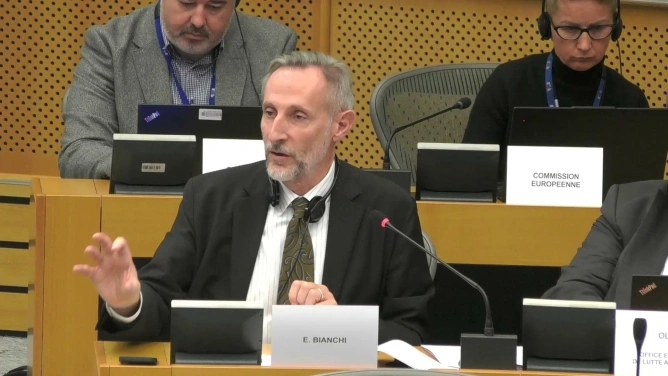
The European Anti-Fraud Office (OLAF) is working on a mechanism whereby data on the illicit tobacco trade, already recorded by authorities in national systems, can be automatically transferred to the European office. The aim is for officials no longer to enter the same information a second time, explained Ernesto Bianchi, OLAF director responsible for revenue and international operations, in the European Parliament’s Committee on Budgetary Control on 3 November.
In brief
OLAF is working on the automatic retrieval of data already reported in national systems, so that authorities do not enter the same information twice. Ernesto Bianchi explained the mechanism in the CONT committee on 3 November.
The project seeks to simplify the exchange of information in combating the illicit tobacco trade. No launch of an operational system or date for connecting national databases has been announced.
OLAF wants to better combine customs and administrative information with information about criminal networks. Access to information from criminal investigations remains subject to limitations, including for OLAF.
The future European customs hub could link anti-fraud information with customs risk analysis. The hub’s timetable is separate from the automatic transfer project described by Bianchi.
The European Court of Auditors found fragmented data, uneven cooperation between states and a lack of systematic evaluation of results. The audit included authorities from Romania, Belgium, Spain and Poland.
Bianchi presented the simplification of reporting as an activity already under way, in OLAF’s response to an audit concerning the fight against the illicit tobacco trade. However, he did not announce the commissioning of a new system, a deadline for the automatic transfers or a list of the databases that would be connected. The mechanism described would avoid duplicating reporting work; his intervention did not announce the removal of a legal obligation to provide information.
For national authorities, the issue is a practical one: information may exist in an internal database, but transmitting it to OLAF still requires another reporting operation. Bianchi said that such requirements can discourage cooperation and consume resources at a time when customs administrations are being called upon to carry out numerous operations, without a corresponding increase in their capacity.
The discussion began with the European Court of Auditors’ special report, which found that information about the illicit tobacco market is fragmented and does not allow a reliable estimate of its size and impact. The auditors examined the actions of the Commission and national authorities during the 2023–2025 period, with checks in Belgium, Spain, Poland and Romania. They also identified differences in cooperation between states, as well as a lack of systematic evaluation of the effects of European measures.
The Court recommends, among other things, supporting states in automatic electronic data transfers and improving the sharing of information needed by OLAF. For this recommendation, the auditors indicate 2029 as the implementation deadline. This is the deadline proposed by the audit, not a launch date announced by Bianchi for the mechanism described in Parliament.
The report cites a Commission estimate according to which the illicit tobacco trade causes annual revenue losses of around €13 billion for the EU and its Member States. The figure should be read alongside the auditors’ finding that sufficiently reliable estimates for the market as a whole are lacking. It does not represent a new assessment of losses in 2026.
In his responses, Bianchi stressed the link between administrative and operational information. Customs data can describe the movement of goods, while information from investigations can show who organises clandestine production or smuggling. Connecting them is important for reconstructing activities that cross several countries and institutions.
This exchange also has legal limits. Bianchi specified that OLAF does not have unrestricted access to information from criminal investigations and that the office is working with Europol to find practical solutions. Cooperation must take into account the differing powers of customs authorities, police and prosecutors, including the European Public Prosecutor’s Office.
A second instrument under consideration is the future European customs hub, the common data platform created through the EU customs reform. Bianchi believes that it could support a process in which information obtained by OLAF feeds into customs risk analysis, while the results of the analysis in turn assist anti-fraud activities. He linked this possibility to cooperation with the new EU Customs Authority and to the concrete form the platform will take.
The hub and the customs authority already have a legal framework through the new Union Customs Code adopted in September 2026. According to the timetable presented by the Council, the authority, based in Lille, begins operating in 2027, while use of the hub becomes mandatory for e-commerce on 1 July 2028 and for all traders on 1 March 2034. The regulation also provides for voluntary use of the hub’s capabilities from 1 March 2031.
This timetable concerns customs infrastructure and traders’ obligations, while the automatic transfer to OLAF seeks to avoid repeated reporting by authorities. The two directions may contribute to better data exchange, but they are not the same mechanism. OLAF, Europol and the European Public Prosecutor’s Office’s access to the hub’s data is likewise subject to the conditions and safeguards laid down in the regulation.
Bianchi argued that the results of cooperation must also be tracked in joint operations, through the ability to identify networks and stop their activities. However, he invoked the independence of the European Public Prosecutor’s Office to explain why an evaluation of the activities of all the bodies involved cannot simply be carried out by the Commission. In this approach, simplifying reporting is a means of making existing information available more quickly to the authorities capable of taking action.
Latest News
20:49
20:47
20:34
20:26
20:14
See more news
NEWS ON THE SAME TOPICS









.webp)