Commission Calls for Ceasefire Before Talks on European Security and Does Not Confirm Visit to Moscow



Always see our news on Google
The European Commission reaffirmed at the 23 November briefing that discussions on Europe’s security architecture must follow a ceasefire in Ukraine and fully involve EU states and NATO allies. The institution says it is aware of Vladimir Putin’s invitation for contacts in Moscow, but has not confirmed receipt of a diplomatic note or acceptance of a visit. The stated objective remains European participation in negotiations in a multilateral format.
Key points
1.The Commission maintains that a ceasefire is a prerequisite for discussions on European security, with the full involvement of EU states and NATO allies.
2.Brussels is aware of the invitation announced by Putin, but has provided no details about its form and has not announced a visit to Moscow. A multilateral format accepted by all parties has not been confirmed.
3.The Commission maintains regular contacts with US envoys Steve Witkoff and Jared Kushner for diplomatic coordination and preparation for possible multilateral negotiations.
4.European representation remains as agreed in Dublin: the EU institutions and the E5, namely France, Germany, Italy, Poland and the United Kingdom. European agreement does not amount to Russia’s acceptance of the team.
5.Separately, the Russian chargé d’affaires was summoned to the EEAS on 20 November, following attacks that affected diplomatic premises in Kyiv.
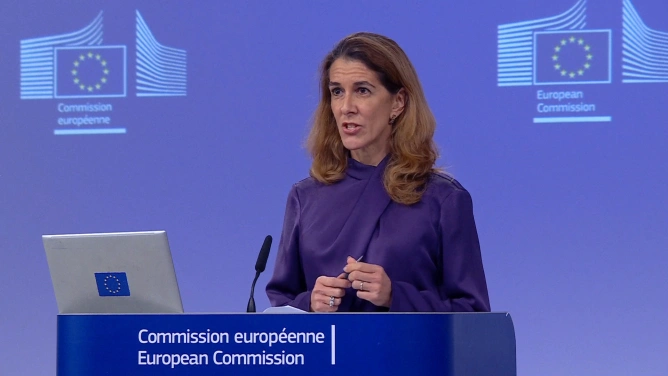
At the press briefing on 23 November in Brussels, Paula Pinho, the Commission’s chief spokesperson, reaffirmed that the institution’s position had not changed. Discussions on continental security should take place in the appropriate forums, with the participation of the actors that would be expected to assume any resulting obligations. She also confirmed regular contacts with US envoys Steve Witkoff and Jared Kushner.
Asked whether the Russian invitation had been conveyed through a letter addressed to Ursula von der Leyen or through a diplomatic note, Pinho replied that she had no additional information about its form. The Commission has not announced the appointment of a delegation to Moscow or an agreement on the location and date of a new meeting.
The Commission’s response keeps preparations for guarantees for Ukraine distinct from negotiations on the security of the continent as a whole. The former is already the subject of consultations between Kyiv, Washington and European partners; the latter could affect institutions, defence commitments and relations among Russia, the EU and NATO.
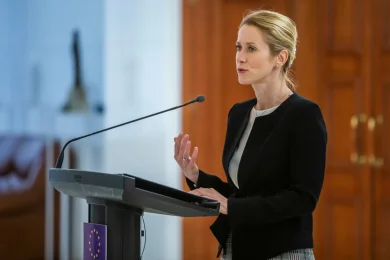
In a statement published on 13 November, Kaja Kallas set out an even more explicit sequence: first a ceasefire, then a peace agreement, and subsequently further discussions on security arrangements. She argued that negotiating a new European architecture before hostilities cease could shift attention away from Russia’s obligation to stop its attacks on Ukraine.
The statement published after the Coalition of the Willing meeting in Berlin on 19 November supports the same distinction. The leaders of Germany, France, the United Kingdom and Ukraine state that broader agreements on European security cannot be concluded while Russia continues its war of aggression. Elements of a negotiation concerning the EU or NATO require the consent of the Union and its member states, respectively of NATO allies.
The Berlin document provides that guarantees for Ukraine, after a ceasefire enters into force, could include sustained military, financial and technical support, participation in a monitoring mechanism proposed under US leadership, a European-led multinational force supported by the US, as well as legal commitments to respond to new Russian aggression, subject to national procedures. Exercise Koalicja-2026, conducted mainly in Poland, is presented as preparation for a possible deployment, not as the activation of these guarantees in Ukraine.
The consultations in Abu Dhabi provided an earlier reference point for expanding the diplomatic format. In the joint statement of 10 November, the European partners, Ukraine and the United States affirmed their objective of advancing towards broader multilateral discussions, with European participation. The document supports Ukraine’s sovereignty, territorial integrity and independent decision-making, as well as NATO’s central role in Euro-Atlantic collective defence.
On 13 November, at the informal meeting in Dublin, European leaders agreed that the team for the peace negotiations should bring together the EU institutions and the E5 from the Coalition of the Willing: France, Germany, Italy, Poland and the United Kingdom. European Council President António Costa called for coordination and unity and stressed that only Ukraine can decide on its territory and sovereignty. The United Kingdom’s presence in this formula reflects its role as a security partner.
At the 23 November briefing, journalists’ questions also addressed possible objections raised by Moscow regarding the participation of the EU High Representative for Foreign Affairs, Kaja Kallas. The institutional response, also given in French, emphasised the agreement among European leaders on representation through the E5 and the EU institutions, rather than the appointment of a single person or the choice of a city for the negotiations. The Commission has not announced any replacement of the format established in Dublin.
A separate diplomatic démarche was confirmed at the same briefing by Christian Wigand, the spokesperson for foreign affairs. Russia’s chargé d’affaires to the EU had been summoned on 20 November to a technical-level meeting within the European External Action Service. The European side raised the issue of damage caused to diplomatic missions in Kyiv and reaffirmed the protection of diplomatic premises under international law.

Latest News
22:57
22:36
22:20
22:05
21:49
See more news
NEWS ON THE SAME TOPICS
.webp)