A meeting with Mikhail Borisovich Khodorkovsky and the dawn of a possible change



Always see our news on Google
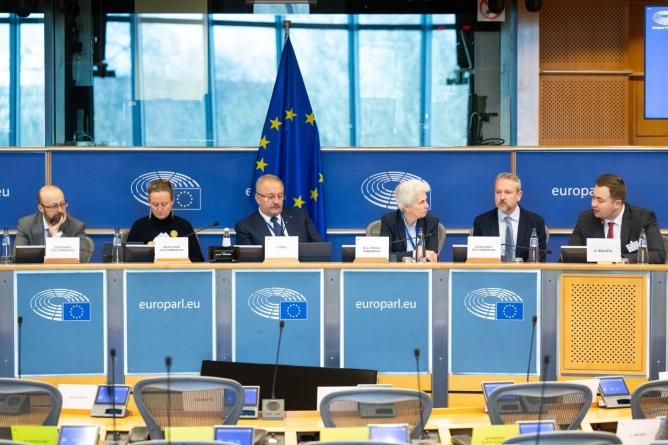
MEP Vasile Dîncu emphasizes that the meeting with Mikhail Borisovich Khodorkovsky, within the EUDS, was more than a hearing, being a test of lucidity for Europe. He points out that hybrid warfare can no longer be treated as an abstract risk, but as a concrete mechanism of influence, intimidation, and control.
The meeting with Mikhail Borisovich Khodorkovsky, within the EUDS, was not a memory exercise, but a test of lucidity. In a Europe that still treats hybrid warfare as an annex to security, his voice came from a place where these tools are not theory. They are practically daily, control, intimidation, discipline.
The hearing within the European Democratic Shield changed the tone of the discussion: we no longer talked about abstract risks, but discussed mechanisms. The Kremlin's blacklists are not an exotic detail, but a power infrastructure that operates simply and clearly: defining the target, public labeling, activating networks, digital amplification, psychological and social effects. The result is not just the discrediting of an individual, but the narrowing of the space for expression for everyone else. This is where their efficiency comes from. They do not just punish the individual, but shape collective behavior.
Europe has underestimated this type of instrument. We have built solid regulations for illegal content, we have invested in transparency, but we have left the central issue unaddressed: distribution. Who amplifies, how messages circulate, at what speed and with what impact?
Here lies the rupture between reality and public policy. The Digital Services Act is an important step, but it is built for another phase of the problem: for moderation, not for coordinated information warfare. Khodorkovsky made it clear: the content itself is not the main danger, but the way it is orchestrated. This idea obliges Europe to rethink its tools, because it is not enough to eliminate what is illegal. We must understand what is strategic. The blacklist does not necessarily violate the law, but produces real political effects: it creates fear, it creates silence, it creates imbalance.
At this point, the European response becomes a matter of will, not knowledge, and three clear directions open up. Recognition: blacklists must be treated as tools of coordinated influence, not as marginal expressions. Speed: the first hours are decisive; without a rapid response, the narrative stabilizes. Finally, protection: those targeted must not be left alone, and the institutional response must be visible and firm.
These things do not require a legislative revolution, but a change of reflex: a shift from procedural neutrality to strategic responsibility.
The meeting with Khodorkovsky also had a dimension that Europe sometimes avoids: confronting its own naivety. We have believed for too long that interdependence brings convergence, that exposure to the market and information opens closed systems. But the experience of Russia shows otherwise: an authoritarian regime can use exactly these tools to extend its control abroad.
This is the hard lesson: technologies that promise openness can be used for closure, and freedom of expression can be exploited to limit expression. That is why the moment in EUDS was not just a hearing, but can be understood as a demarcation line between a Europe that analyzes and a Europe that acts.
Khodorkovsky did not come with metaphors, but with mechanisms and a simple warning: if you do not understand the logic of the system, you will always react too late. Europe no longer has the luxury of strategic innocence. It must learn quickly and respond accordingly. It must not respond through imitation, nor by restricting freedoms, but through institutional intelligence, through the ability to see where the real effect occurs: in distribution, in the perception process, in the effects on behaviors. That is where European democracy is played today.
A good political opportunity
These days, we are discussing, in the group of socialists and democrats, about a "Strategic Turn." It is not the first time that the European social-democratic family proposes a recalibration, but this time, the context no longer offers space for ambiguity.
External pressure, internal fragmentation, and technological acceleration compress political time. A strategy that does not produce quick effects becomes irrelevant before it is implemented. The problem is converting this reflection into tools. There is a visible distance between discourse and mechanism, between intention and operational architecture. A real "Strategic Turn" starts exactly here: in the ability to translate general themes into concrete devices, with clear responsibilities, precise deadlines, and verifiable indicators. Without this translation, the strategy remains an exercise in positioning, useful perhaps in negotiations, but ineffective in transforming reality.
This limit becomes especially evident in the area of disinformation and hybrid warfare. Europe has built a relevant normative framework, especially through the Digital Services Act, but this framework reflects a partial understanding of the problem. If S&D wants to mark an authentic change, it must have the courage to shift the regulatory weight: from content to distribution, from moderation to visibility architecture. This is not a technical adjustment, but a paradigm shift.
It means recognizing that power in the digital space no longer belongs exclusively to the one who produces the message, but to the one who controls its circulation. It means introducing real obligations for platforms regarding how they amplify, prioritize, and propagate political content. It means accepting that transparency without accountability changes nothing.
In parallel, the issue of speed arises. European institutions are built for deliberation, not for immediate reaction. This has long been a virtue, but today it becomes a vulnerability. Actors operating in the logic of information warfare do not respect the European institutional rhythm. They act quickly, coordinated, and opportunistically. The time difference between the occurrence of an incident and the institutional response becomes a systematically exploited space. In this interval, the narrative fixes, emotion stabilizes, perception crystallizes.
A credible "Strategic Turn" must address this problem head-on. Not by abandoning deliberation, but by complementing it with rapid response mechanisms. The response protocol in the first hours becomes essential, as well as message coordination, activating dedicated teams, and assuming a clear voice at the European level. This is not about propaganda here, but about presence. Institutional absence at a critical moment is not neutrality, but ceding ground.
Equally important, in the case of hybrid warfare, is the protection of exposed actors. Blacklists, coordinated stigmatization campaigns, and reputational attacks do not just aim to destroy an individual career. They produce a broader effect: they create a climate of fear and self-censorship. Delimitation becomes risky, criticism becomes costly, and, over time, the public space shrinks without a formal intervention of censorship. This is the efficiency of these tools: they do not prohibit, but discourage and lead to self-censorship.
The European response must understand this logic. Legal protection is not enough; a visible, solidary, and rapid political response is necessary. Those targeted must not be left alone in the face of a coordinated mechanism. In the absence of such a response, the effect of the listing amplifies, and silence becomes part of the mechanism.
Economically, the discussion about strategy cannot avoid the issue of social credibility. European social democracy has promised mobility, security, and equity, but, in many cases, it has delivered administration, and the difference is felt by the electorate. A "Strategic Turn" without anchoring in concrete economic life risks being perceived as a discursive rearrangement, not as a real change. Reindustrialization, investments, the green or digital transition must be explicitly linked to tangible social effects: jobs, income, stability. Without this connection, the social-democratic discourse remains abstract.
At the same time, the issue of ideological clarity cannot be avoided. The current political competition penalizes ambiguity. Voters no longer respond to broad, balanced, but vague formulas. They seek recognizable, coherent, and supported positions. For S&D, this means an unequivocal reaffirmation of principles: reducing structural inequalities, democratic control over the digital economy, a social state that prevents, not just compensates. Perhaps political opponents will say that it is a return to the past, but it is not. It is an update of the mission in the conditions of the present.
All these dimensions converge into a broader question: what kind of actor does Europe want to be — a regulatory space or a strategic actor? The difference is not semantic. It defines the capacity to act in a competitive, conflictual, and unstable environment. An authentic "Strategic Turn" for the Progressive Alliance of Socialists and Democrats involves taking on this question and formulating a coherent response.
We are discussing these days in the political group and see that the problem is not the lack of ideas, but sometimes the lack of will to turn them into action. Strategy begins where discourse stops: in decision-making architecture, in the speed of response, in the clarity of positions. If this step is taken, change becomes visible.
Latest News
23:03
22:44
22:40
22:37
22:34
See more news